

How much should rural electric co-ops budget for vegetation management? Most should allocate 15–25% of their distribution maintenance budget, though this varies based on tree density, growth rates, and the current maintenance cycle.
Vegetation management is typically the largest expense in utility operations and maintenance budgets. Getting your budget right prevents costly service interruptions while avoiding overspending on unnecessary maintenance (Intren. (n.d.). Vegetation management. https://www.intren.com/capabilities/vegetation-management/).
Why Vegetation Management Costs Vary by Co-op: Key Factors That Shape Budget Needs
- Tree density in service area (trees per mile of overhead line)
- Predominant tree species (fast-growing deciduous vs. slower-growing conifers)
- Length of maintenance cycle (3-year vs. 5-year vs longer schedules)
- Geographic location (growing season length and climate)
- Current state of maintenance (deferred maintenance costs significantly more)
How Deferred Maintenance Multiplies Costs
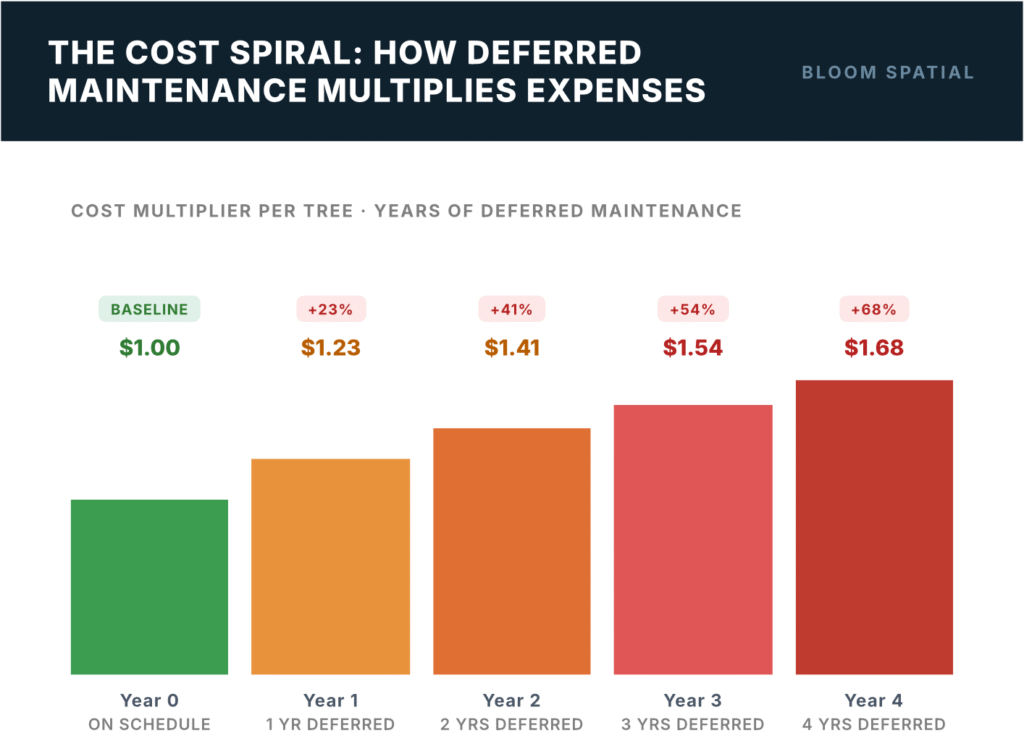
Deferring vegetation maintenance just one year beyond your optimal cycle increases pruning costs by 20-25%. Push it four years and costs jump 65-70%. This happens because branches grow larger, more numerous, and more intertwined with conductors.(Browning, D. Mark, and Harry V. Wiant. “The Economic Impacts of Deferring Electric Utility Tree Maintenance.” Journal of Arboriculture 23, no. 3 (May 1997): 106-112.)
Many co-ops unknowingly enter a cost spiral: deferred maintenance increases expenses, tighter budgets force more deferrals, and costs accelerate exponentially.
Recommended Budget Allocation Strategy: Start with a workload assessment:
- Conduct a random-sample survey of your service territory
- Count trees per mile and incompatible target brush by density
- Project total workload across your system
- Calculate man-hours and equipment needs for your chosen cycle
Use this framework:
- 3-year maintenance cycle = 33% of vegetated line-miles annually
- 4-year cycle = 25% annually
- 5-year cycle = 20% annually
Add these contingencies:
- 10-15% for emergency/storm work
- 5-10% for new construction clearing
- 5% for specialized treatments (herbicides, tree growth regulators)
The Cost-Effectiveness Sweet Spot
Underfunding vegetation management creates more outages and ultimately costs more. Overfunding wastes member dollars on unnecessary maintenance. The sweet spot is funding enough to complete your entire service area on an appropriate maintenance cycle, typically 4 to 5 years for rural co-op systems.
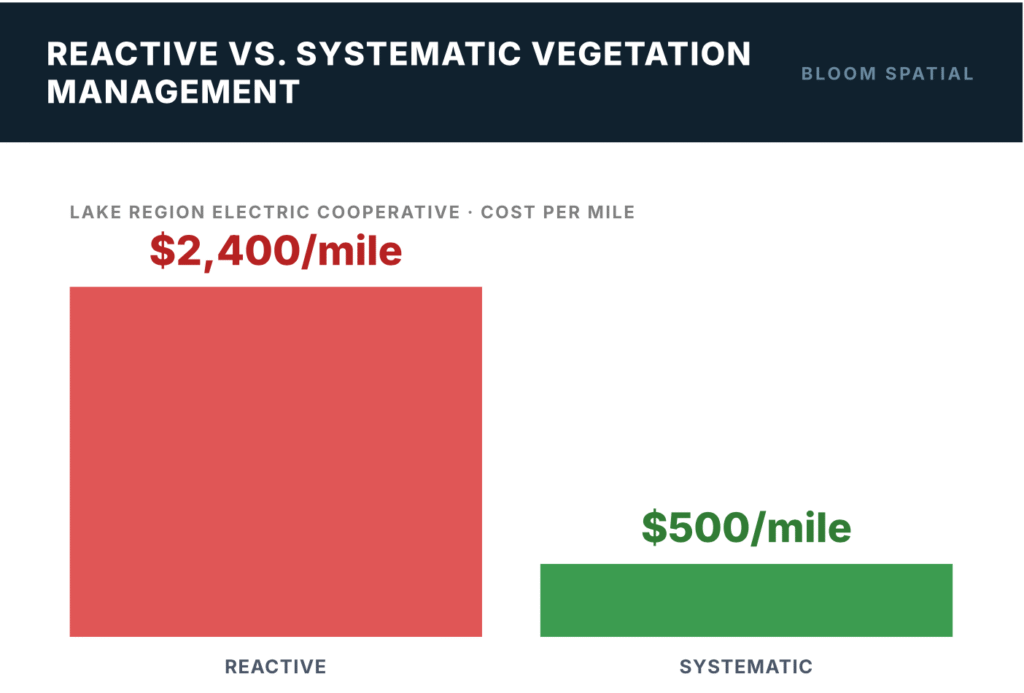
The most cost-effective cooperatives maintain proactive, systematic schedules rather than reactive, emergency-driven approaches. For example, Minnesota’s Lake Region Electric Cooperative reduced costs from $2,400 per mile to $500 per mile by switching to a systematic approach.(“Making vegetation management a strategic priority,” Renewable Energy World, October 14, 2025. https://www.renewableenergyworld.com/power-grid/making-vegetation-management-a-strategic-priority/)
Key Takeaway
Budget vegetation management based on your actual workload, not historical spending. A proper inventory-based forecast prevents both service reliability problems and budget surprises.
Most rural electric cooperatives should allocate 15 to 25% of their distribution maintenance budget to vegetation management. Deferred maintenance creates a cost spiral, with expenses jumping 65 to 70% after four years of deferral. The most cost-effective approach is funding a complete maintenance cycle every 4 to 5 years using proactive management.
Leave a Reply