

Best-practice pruning techniques slow tree growth toward conductors, often significantly, extending your maintenance cycle and cutting long-term costs.
Most electric cooperatives inherited decades of historic trimming practices. Techniques like topping, stubbing, and rounding over cost less upfront but drive higher expenses over time. Switching to best-practice pruning requires training and supervision, but it pays off.
The Three Most Costly Trimming Mistakes
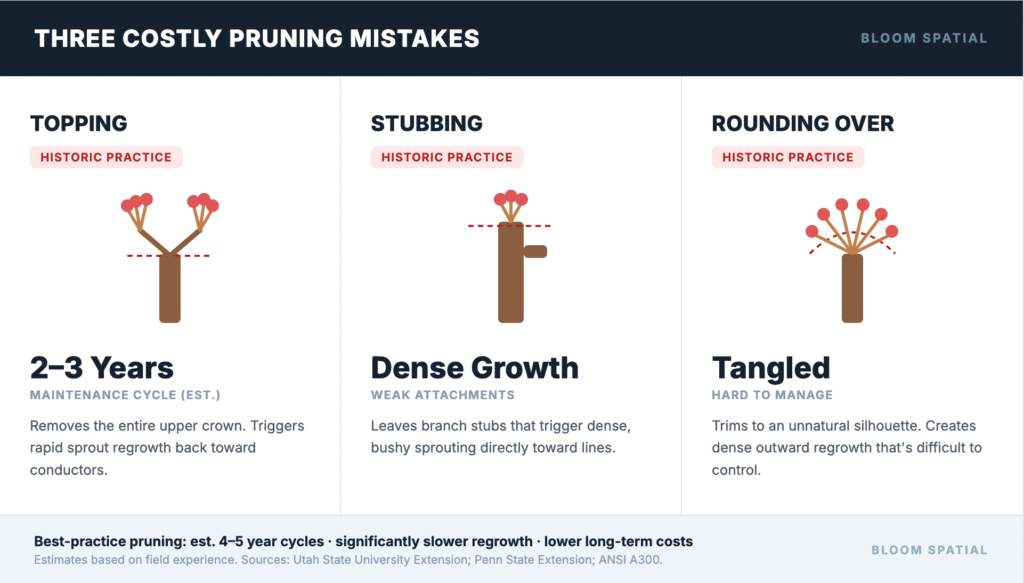
1. Topping (Removing the Entire Upper Crown)
- Creates dozens of weakly-attached sprouts
- Sprouts grow rapidly back toward lines
- Requires maintenance every 2-3 years instead of 4-5 (estimate based on field experience)
- Disfigures trees and creates hazardous conditions
- Many municipalities now prohibit it by ordinance (California Public Resources Code, GOV § 53067; ISA Tree Ordinance Guidelines)
2. Stubbing (Leaving Branch Stubs)
- Triggers vigorous sprouting from multiple buds on the stub
- Results in denser, bushier regrowth directly toward conductors
- Creates an unnatural appearance that generates property owner complaints
- Creates weak branch attachments prone to failure
3. Rounding Over (Shearing the Entire Crown)
- Leaves trees in an unhealthy condition
- Rapid sucker growth returns immediately toward lines
- Creates dense, tangled regrowth harder to manage
- Requires frequent, expensive maintenance cycles
How best-practice Pruning Works
Natural pruning redirects growth away from lines by: (Utah State University Extension; Penn State Extension)
- Cutting branches back to suitable lateral limbs
- Making cuts at the branch collar without removing it
- Allowing the tree’s natural defenses to compartmentalize the wound
- Directing remaining branches away from conductors
Key technique differences:
- Proper cuts: At the branch bark ridge, leaving the collar intact
- Improper cuts: Flush with the trunk or leaving stubs
- Proper removal: Back to laterals or the main trunk
- Improper removal: Uniform cuts creating stubs
Training Your Crews for best-practice Pruning
Implementation requires:
- Clear specifications in all contracts and SOPs
- Crew training on ANSI A300 standards and proper techniques (Tree Care Industry Association, treecareindustry.org)
- Regular audits to verify compliance with standards
Most co-ops see meaningful productivity improvements once crews master proper techniques because trees require less frequent maintenance (estimate based on field experience).
The Economics
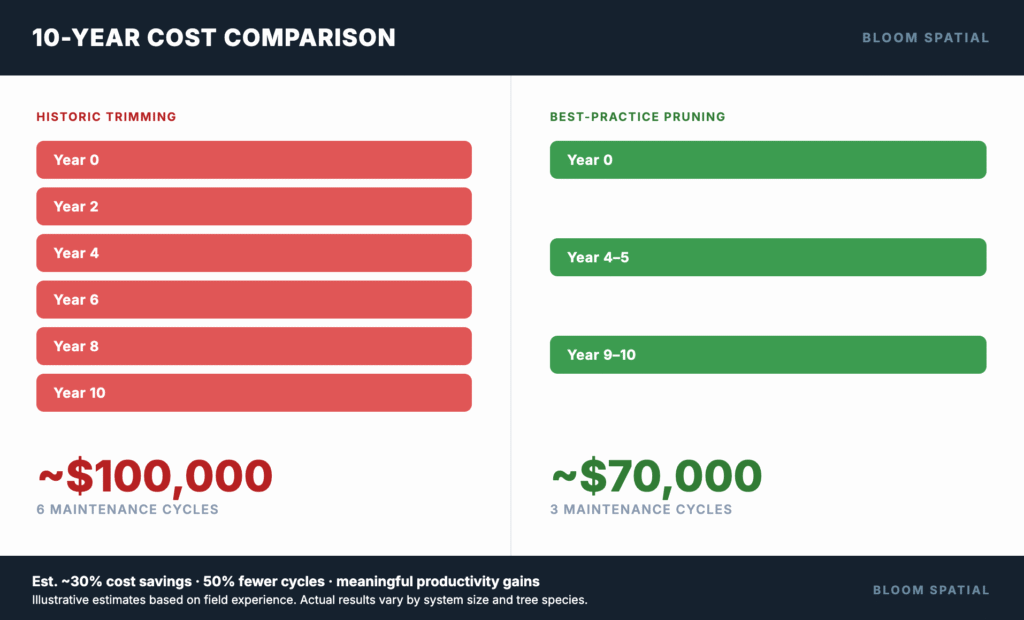
Best-practice pruning costs slightly more per cut but requires maintenance less frequently. Over a 10-year period, systems using proper techniques typically spend 20-30% less than those using improper trimming.
Converting Your Program
If your system has years of improper trimming, don’t expect immediate perfection. Many improperly trimmed trees are too damaged to save and should be removed. (Utah State University Extension)
For new pruning work, enforce best-practice technique consistently system wide. Property owners may notice trees look different initially, so use your public relations program to explain the benefits.
Bottom line: Train your crews on best-practice technique and the cost savings compound for years.
Leave a Reply