

Selective herbicide application is the only method that permanently reduces incompatible target brush, which is why it’s critical for managing costs long term.
Many rural co-ops avoid herbicides due to perceived environmental concerns or public resistance. This often backfires. Without herbicides, hand-cutting and mowing encourage brush regrowth, requiring maintenance every 2-3 years instead of 4-7 (Richland Electric Cooperative, “Vegetation Management”).
Why Herbicides Are More Environmentally Sound
Targeted herbicide use is more environmentally responsible than the alternatives:
- Hand cutting alone triggers stump sprouting, increasing plant density and requiring more frequent maintenance
- Mowing only eliminates compatible low-growing vegetation and encourages tall-growing species
- Mowing + herbicides reduces chemical use over time by establishing desirable plant communities
- Selective herbicides target only invasive species, preserving compatible vegetation
The goal isn’t herbicide-free management. It’s achieving a low-growing, stable plant community that minimizes future maintenance (T&D World, “Benefits of IVM: Cost Efficiency”).
A 20-year present value cost analysis found that IVM programs consistently delivered cost savings of 25-57% compared to repeated mechanical mowing alone. When utilities lose access to herbicides after years of IVM practice, the cost of returning to mechanical-only management increases by an estimated 31% over the following decade (Corteva Agriscience, “Benefits of IVM on Utility Rights-of-Way”).
Three Phases of Herbicide-Based Vegetation Management
Phase 1: Initial Clearing (Year 1)
- Heavy-density, tall brush requires broadcast foliar application
- Herbicide applied to entire area at fixed rate
- Results in “brownout” appearance for 2-4 weeks
- Best suited for rural areas away from public view
Phase 2: Conversion (Years 2-4)
- Brush density drops significantly
- Switch to selective, directed applications
- Target individual tall-growing stems
- Low-growing, compatible vegetation establishes
Phase 3: Maintenance (Years 5+)
- Minimal herbicide required
- Only scattered tall-growing stems need treatment
- Stable plant community suppresses regrowth naturally
- Maintenance cycles extend to 5-7 years
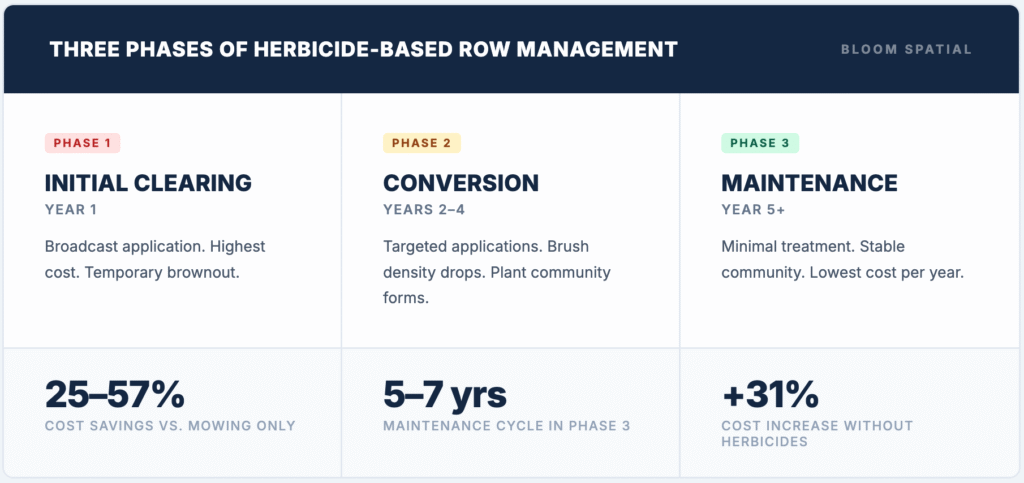
(T&D World, “Use IVM and Herbicides as a Least-Cost Approach”; Co-Mo Electric Cooperative, “Best Practices for Utility Vegetation Management”).
How you apply herbicides matters as much as when. The right method for the right site is what separates an effective program from an expensive one.
Herbicide Application Methods for Co-ops
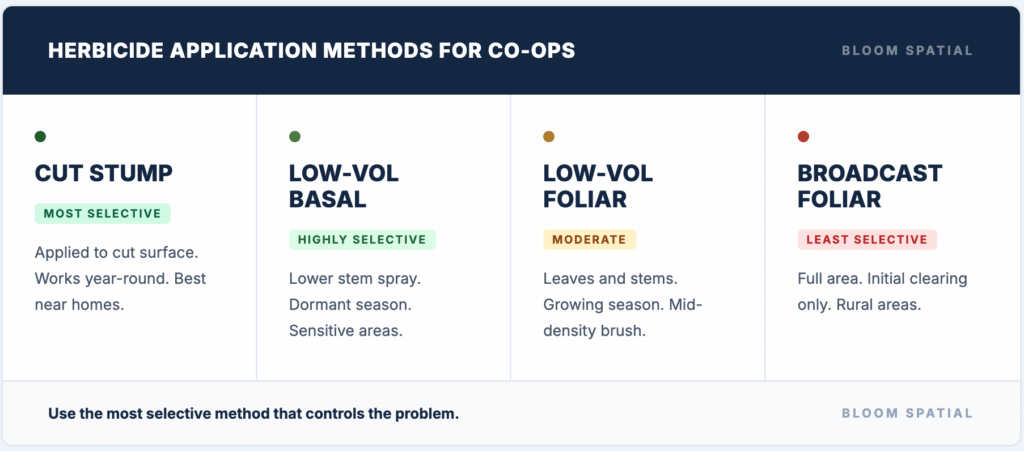
Cut stump treatment (most selective, best for areas near homes)
- Apply herbicide immediately after cutting
- Prevents resprouting of deciduous trees
- Minimal off-target damage risk
- Year-round application possible
Low-volume basal application (highly selective)
- Spray lower 12-18 inches of target stems
- Can be applied dormant season
- Requires skilled applicators
- Best for scattered stems in sensitive areas
Low-volume foliar application (moderately selective)
- Spray leaves and stems of target plants
- During active growing season only
- Requires operator skill to avoid non-targets
- Good for moderate-density infestations
Broadcast foliar application (least selective)
- Fixed rate applied to entire area
- Most cost-effective for heavy infestations
- Results in temporary brownout
- Only for rural areas
Public Relations Strategy for Herbicide Programs
Property owners accept herbicide use when co-ops:
- Provide advance notification of application
- Explain why the treatment is necessary
- Demonstrate that applications follow EPA-approved label directions
- Show compliance with all local regulations
- Document environmental stewardship approach
(First Electric Cooperative, “Vegetation Management”; Co-Mo Electric Cooperative, “Best Practices for Utility Vegetation Management”).
Co-ops should avoid herbicides only in extremely sensitive areas (near wells, sensitive wildlife habitat) or where public opposition is absolute.
Cost Comparison
Herbicide-based programs cost more initially but deliver significant long-term savings. Most co-ops recoup the investment within 5-7 years through reduced maintenance cycles and lower labor requirements (U.S. EPA, “Benefits of Integrated Vegetation Management on Rights-of-Way”).
Key insight: The most cost-effective approach combines herbicides with mechanical methods based on site conditions and brush density (Tree Fund /Goodfellow, “The Cost-Efficiency of IVM”).


Leave a Reply